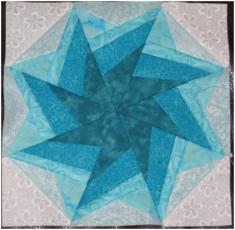
Stardust Pinwheel Tutorial


This is the block I chose for my Pinwheel Block Swap on Flickr. There have been a lot positive comments and requests for the block, so I am posting the pattern here for everyone to enjoy. You will need to print 2 copies of each page to create the pinwheel. The templates are numbered in the order to piece them. They are also lettered but you can ignore the letters

You only need a basic knowledge of paper piecing to complete this block, which is why it is such a good one to start with. You get stunning visual results with any color combination! You can piece it anyway you like, or you can follow the tutorial below.

Instructions


Cut out your templates and place them into two piles as shown. 4 blocks will have corners, 4 will not. Pick out the fabrics you want for each part of the pinwheel.


I like to pre-cut my fabric strips. This way I know I have enough to cover the block, and I can chain piece my block. The templates with corners are numbered 1-6, the templates without corners are numbered 1-5. For the sake of the tutorial I will refer to the numbering for the blocks without corners. The templates are identical once the corner is sewn.

The numbers in the brackets indicate the position numbering for the templates without corners.

Cut your fabrics as below:

1 = 2 squares 4 ¼”x 4 ¼”” cut into Half Square Triangles ( yields 4 HST)

2 (1) = 8 strips 6″x 2″

3 (2) = 8 strips 3 ¼” x 2″

4 (3) = 8 strips 5 ¼” x 1 ½”

5 (4) = 8 strips 5″ x 2″

6 (5) = 8 strips 4 ½” x 3″

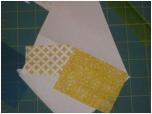
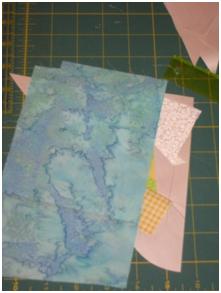
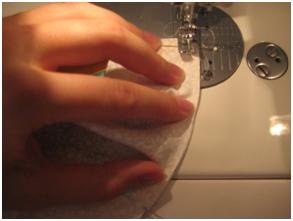
Start with the 4 templates with corners. Place the HST right side up on the unprinted side. Take strip #1 and place it Right Sides Together on the HST, as shown below. Hold the block up to the light, printed side facing you, so you can line up the seam allowance. Sew on the first line. Repeat for the remaining 3 templates.


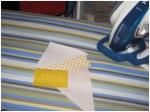
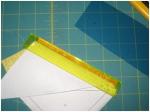
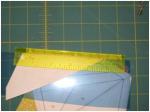
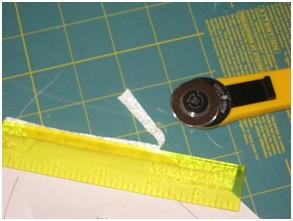
Press the blocks ( no steam). Place a straight edge along the next sewing line, fold the paper back along that line (tearing paper from the previous stitched line as needed), and trim the seam allowance to ¼” using an Add-a-Quarter Ruler (or whatever your preferred method is). Set these pieces aside for now.


Take your 4 Templates without Corners and place strip #1 Right Side Up on the unprinted side of the template. Use the light trick to make sure the entire section is covered. Baste the strip in place on the dotted cutting line or in the extra paper outside the template. This will hold your fabric in place. Place your straight edge along the sewing line, turn the paper back, and trim the seam allowance. (It is the same line as shown above)
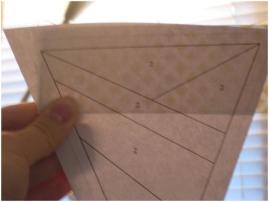
Light trick

From here on you can piece all 8 templates at the same time. It goes together quickly from here!

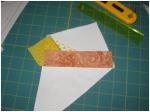
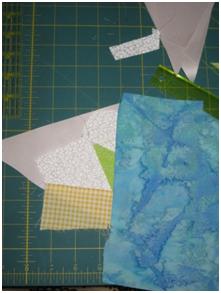
Take strip #2, place it RST with strip #1. Sew and press. Place your straight edge along the next sewing line and trim the seam allowance as before. Repeat these steps for the remaining fabric strips.

Here is a photo montage of the rest of the piecing process (‘Cuz everything is better with a montage! MONTAGE!) Enjoy!

RST

Sew

Press

Trim

(oops, no picture)

(oops, no picture)

Trim round the templates on the dotted line. Voila! 8 wedges ready to be sewn into your block!
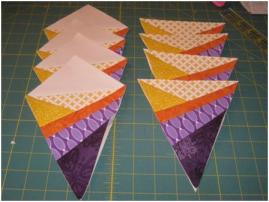

Voila!

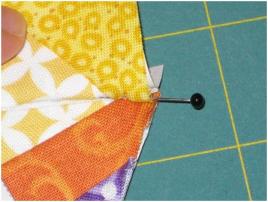
Place a no-corner wedge RST on top of a with-corner wedge. Pin together at the top and bottom by placing a pin through the points at the top (black) and bottom (white) so it is loose, as shown. Line up the seam allowances. Hold the bottom firmly so the pieces don’t move and secure by pinning normally.

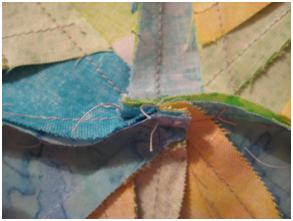
At the top there is a lot of bulk because you have seams meeting as well as the paper. If you were to pin through all the layers you end up with a humped area that can be bulky and messy to sew through.
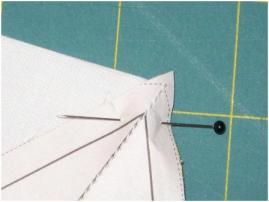
Bulk Hump

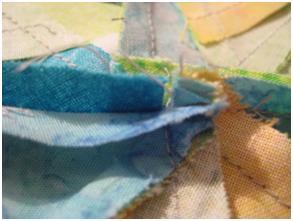
To avoid this you need to pin through the FABRIC ONLY. This keeps the pieces from humping up.
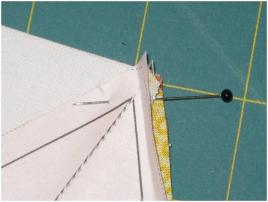
Through the fabric only

Sew the seam, pull the paper out of the seam allowance, and press your blocks in the same direction (this is important later!). You now have 4 quarters. Sew your quarter together into half blocks using the same process outlines above, making sure that the bottom points are well matched. Sew your seam and press in the same direction as before. Your points should match.

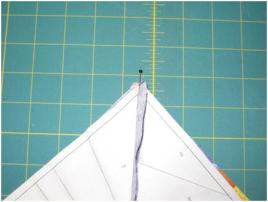
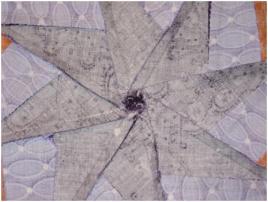
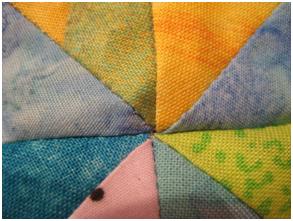
Sew your final seam, pinning at the corners and at the center point. If you want to make sure your points match, use the technique from the Wonky Compass Tutorial, or you can pin and sew just through the center, then open and check your alignment. If you are happy with the alignment sew your final seam. Press the last two seams in the same direction as the rest, and use the technique from the Wonky Compass Tutorial to press your center flat. Tear out your paper and do a final press with steam. Trim and clean up the edges of your block, and your done!

Where Does the Time Go?

Holy Cow.

Is it almost September already? Yup, apparently it is according to my phone, computer, and AQS wall Calender.

August always seems to fly by for me. There were the 10 days on vacation, 5 days waiting for a new video card after the crash of my computer, starting a new quilt for the 2013 CQA Quilt Show (in Penticton this year, only a 5 hour drive! Woo-hoo!), <—- Apparently Woo-hoo is not in the spell check dictionary but woo-bop is. Go figure. I also started the blocks for the 3×6 block swap I am participating in, and the name tag for the RATZ Swap. For those who want to know, RATZ stands for Rapid Tiny Zakka. Zakka means many tiny things in Japanese, so that’s what we make. The last month was needle-books, month before that was key chain tags. I am sorry I missed the needle-books because they look so cute. I am looking forward to the future swaps though. I actually finished my name tag on time and sent it to my partner in New York state. I hope she likes it.


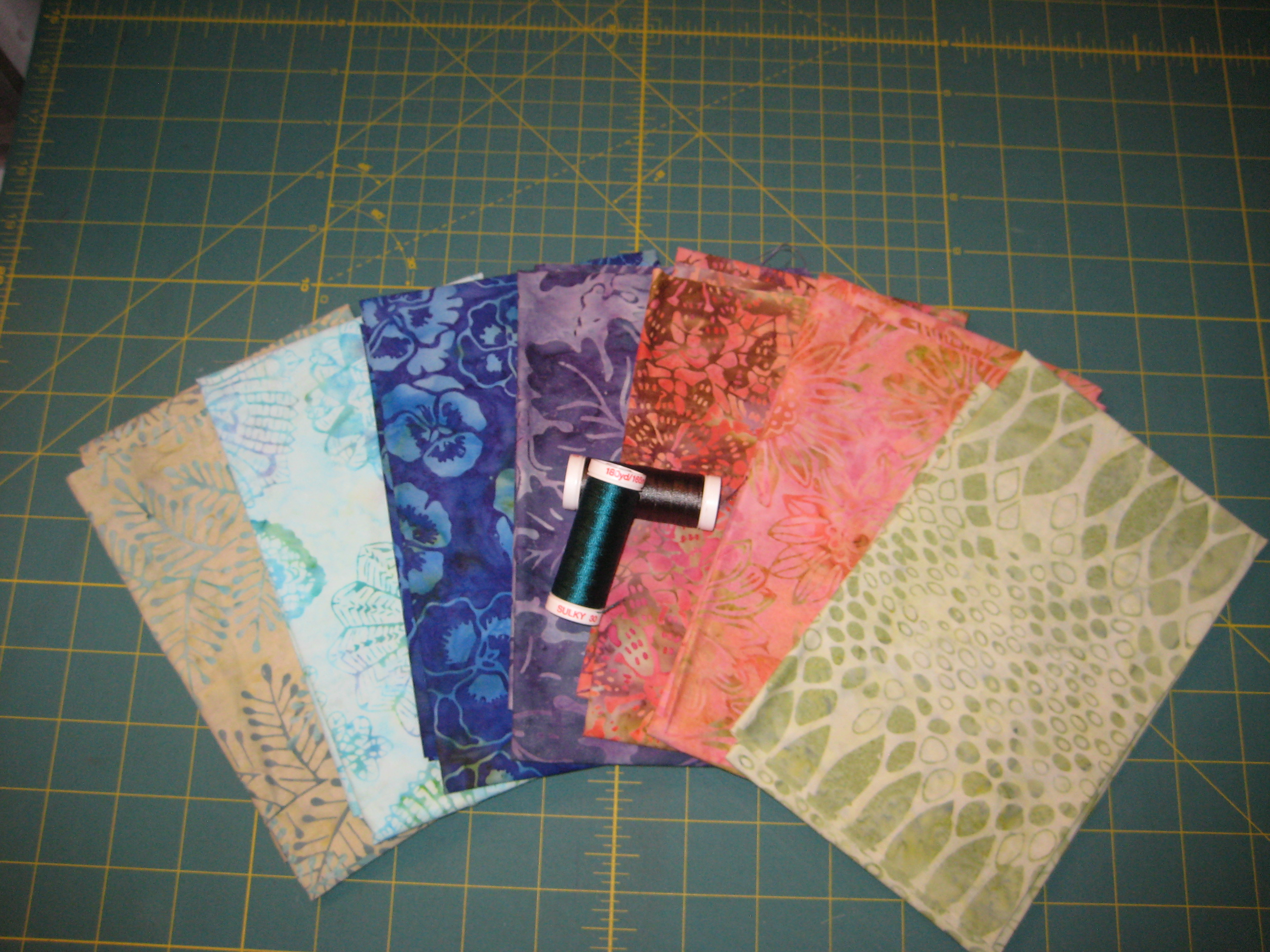
I also received my packets from the Hoffman Challenge. This year marked the 25th anniversary of the challenge, so to celebrate for every 25 entries they would pull a name out of a hat and send off a packet of Hoffman Batiks and Sulky Threads. I got home from vacation to find this package at my door! I love the colors, especially the peacock thread! Batiks are my favorite fabrics, so I was giddy when I got the email saying I had won a prize draw!

I also found a second packet from Hoffman with my letter of acceptance into the trunk show and the goodies they send along: a beautiful cloche pin,  Sulky thread, and a fat quarter of a Hoffman screen print.

I am always excited when my quilts are chosen to be in a show. Even though I don’t win ribbons it is an honor to have my work displayed with some of the best from around the world. I was very excited in 2010 because my quilt Starfire was in the same traveling trunk as Fly Away by Jaqueline de Jonge, who you all know if one of my favorite inspiring quilters! Solaris, an original design, was also chosen to travel in 2011. It should be arriving home in October.

I have been participating since 2010, and I look forward to the new fabric each year. When 2012 was revealed, I was aghast. Its not that the fabric was terrible, its just not my thing. Right up Grandma’s alley, but definitely a few blocks and a kitty corner from mine. But that’s why they call it a challenge, right? Last year, when I had lots of time to sit and draft, I replicated the pieced inner panel from the Claudia Clark Myers/Marilyn Badger collaboration Greensleeves. (I did not include the applique.) Then I emailed Claudia Clark Myers and received permission to sew it up and enter it into the challenge.

I ended up going a different direction last year, but I found for 2012 it was the perfect pattern to showcase and at the same time hide this fabric. Again let me emphasize that while the fabric is nice, it is just REALLY not to my taste. The effect was charming, and I named the quilt My Secret Garden.

The fabric for 2013 is stunning, and I am so happy that it is in my palette. It has quite a large repeat as well as a huge amount of visual content in the repeat. I have an Idea forming for what I want to do. Now the waiting game begins until I can pre-order my fabric from one more of the online retailers. This one will sell out fast!

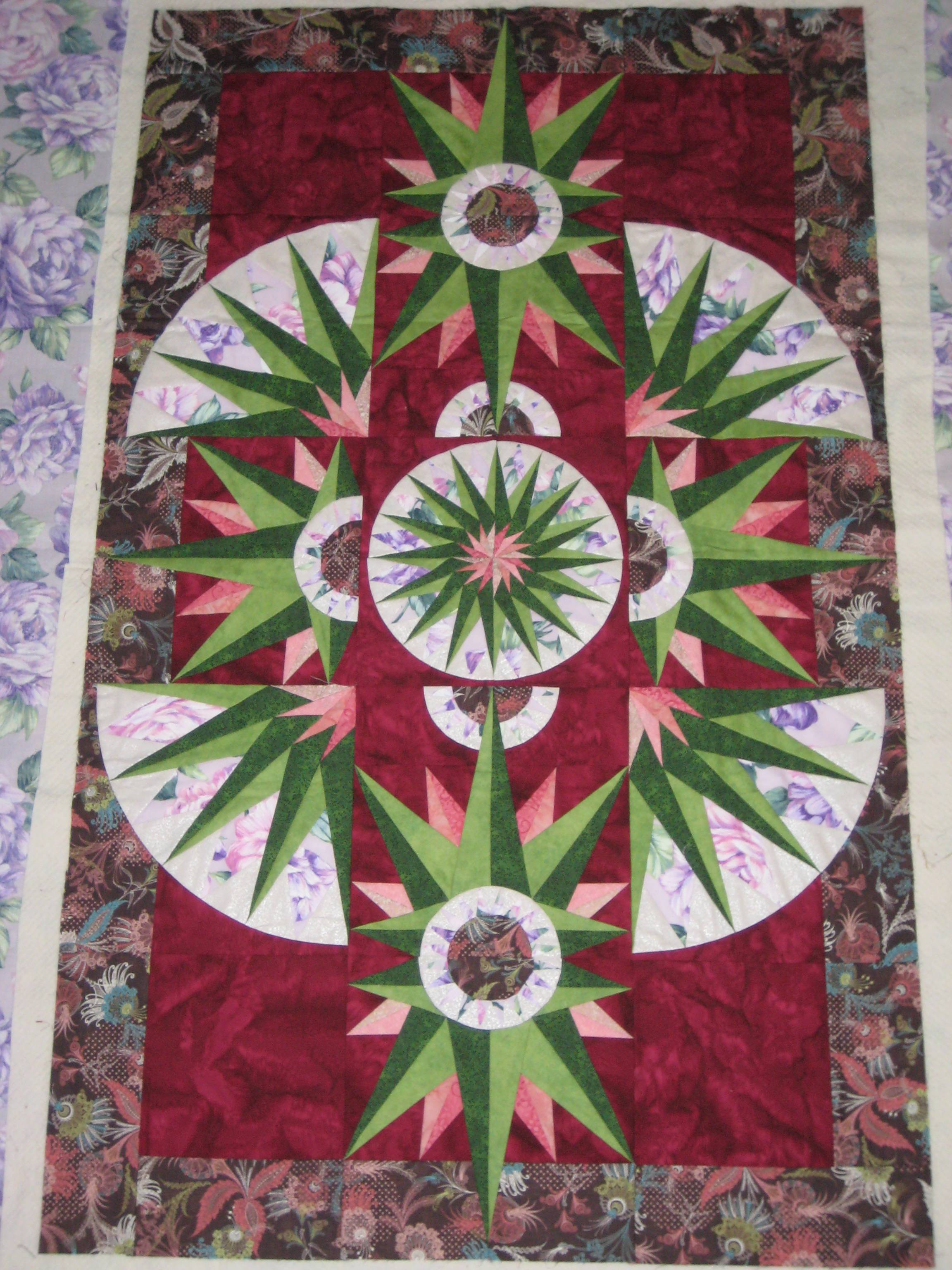
While I was away I started working on my entry for the Canadian Quilters Association Juried Quilt Show. I am making the Jaqueline de Jonge pattern Listen With Your Eyes. Here is a sneak peek at what I have completed so far! My color wheel has more than 100 different fabrics, not a single fabric repeats! I pulled all but 9 from my stash, somehow I was a tad low on yellow/lime and aqua. This is the original quilt, and I got the pattern here.


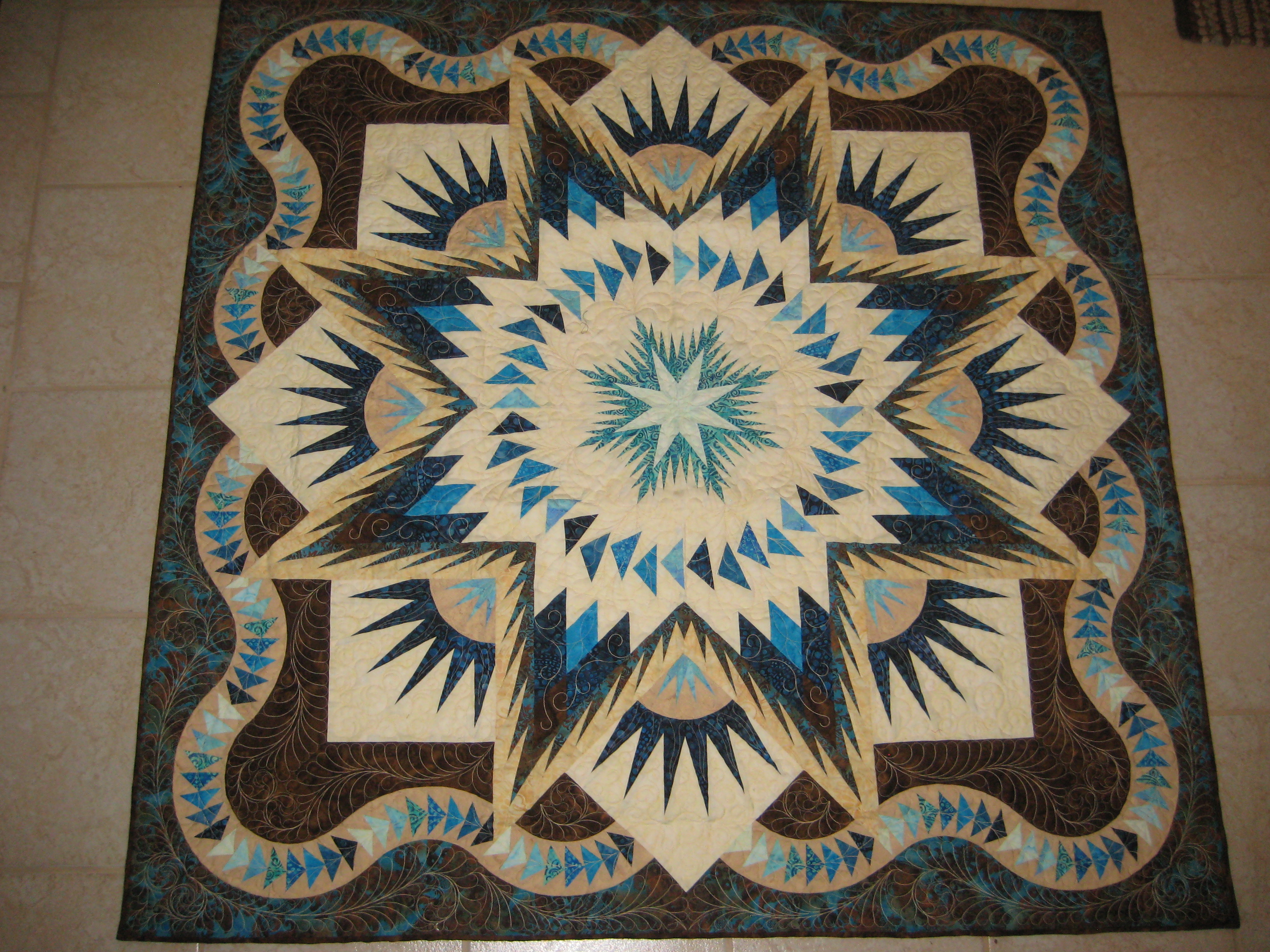
I also received my Glacier Star quilt back from Julie House of Sculptured Threads Quilting in Arizona. She did an amazing job and I highly recommend her. You can check our her work on Facebook. I am going to enter this quilt into the Georgia Quilt Show. I need to think of a name, any suggestions?


Thanks for being so patient with me! The gallery should be up and running in a week or so. As always, Happy Quilting!

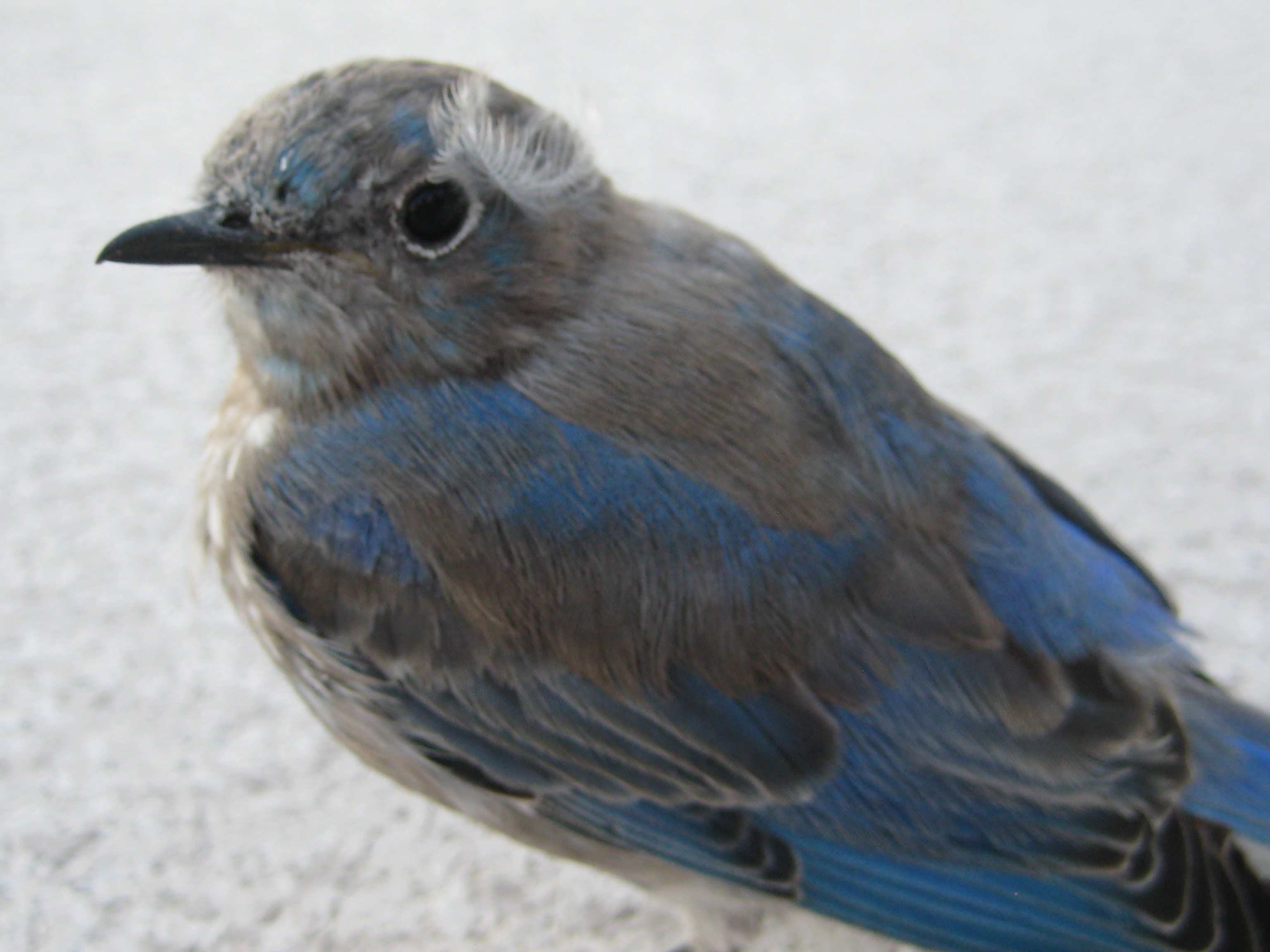
This little fellow was out on my parents deck. The Mountain Bluebirds were out full force one evening, and he had a small run in with the window. I picked him up so he could get over the deck, and he is now happily living in the back  forest.

A New World for Baby Quilts

Does it ever seem like when one friend has a baby, suddenly everyone is having babies?? Not that I’m complaining, because it means getting to make lots of super cute baby quilts! I love the selection of spunky, modern fabrics available right now for babies and children. Especially all the owl prints. I love owls, and its so great that they are in right now! The only problem I’m having is that the owls all seem to be in little girl colors! I love how they look, but I don’t think my son would enjoy a hot-pink and green owl quilt as much as I would *sigh* so I slowly walk on past and find the blues, greens, yellows, oranges, reds and  browns. Don’t get me wrong, I love what they have for baby boys, such a breath of fresh air over baby blue, white, and more baby blue. But maybe they might consider all these adorable little owls Ok, I found that they do make all those adorable little owls in that palette! Zoologie from Robert Kaufman!

Anyhow, I digress!

One of my best friends, M.H. just welcomed a new little girl into her family. Born yesterday morning at 9lbs 13 oz, and she came in just under 3 hours, all natural, though not by choice I’m told! M.H. is a champion, and they chose the most beautiful name for their little girl. So yesterday baby H and I went to the fabric store and picked up some cotton prints and a pastel mint minky, and we whipped up a crib sized quilt.

I always make my baby quilts 45″x60″ ( or somewhere around that mark) because its the perfect size to lay baby on the floor to play, and when baby is old enough to use fluffy quilts safely (not until after 9 months) it will fit their beds and their growing bodies. On average, a 60″ long quilt can be used as the main covering until the baby hits 3 years old. Sometimes longer, depending on the child’s growth.  After that they are the perfect size to cuddle up with on the couch, floor, wherever your child wants, AND it works as a bed runner!

Since I plan baby quilts to last so long, I always choose colors and prints that are fresh, bright, and fun so that as they get older the child doesn’t feel that the blanket is too babyish. I always back with either minky or flannel so its always warm and cuddly, and I do an all-in-one backing/binding. I love this method, as it keeps the corners soft and flexible, and keeps the binding from becoming too bulky. It is also much easier than trying to use minky in traditional binding methods, minky is naturally stretchy and can be finicky.

Here is the finished baby quilt. I used the Turning Twenty block with only 6 fat quarters instead of twenty, and added 3 1/2″ borders. It makes a perfect crib size!

Enjoy!


Fabrics:

Urban Zoologie by Ann Kelle for Robert Kaufman

Good life by Deena Rutter for Riley Blake Designs

Hoos In the Forest by Doohikey Designs for Riley Blake Designs

Get Together by David Walker Studios for Free Spirit

Baby Safari by Carina Gardner for Northcott

Wonky Compass Tutorial

Alrighty, for all my Modern Quilt Guild friends (and anyone else who enjoys modern/wonky quilting), here it is! The Wonky Compass Tutorial with 2 methods of construction! I did half of my blocks freestyle and half pre-marked. For those of you who are unsure about freestyle paper piecing the pre-marking method is best.

You need scrap fabric (3 colors per wedge), a marker and straight edge ruler , 8 wedge templates to create the circle, and a template for the border to make the block square. If you need one, you can use my  Quarter Compass Wedge and Template. The template finishes 12″square.

FREESTYLE METHOD

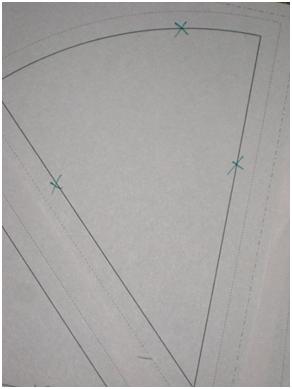
Mark out 3 points on your wedges, one on the upper curve, and one on either side

Lay your first main fabric (yellow) RIGHT SIDE UP on the blank side of the paper. Lay your first scrap of background fabric (white) right sides together (RST from here on out) with the main fabric. Sew a straight line from the center mark to the right side mark.


If your line doesn’t cross the mark, that’s ok!


Check to make sure the fabric covers the section from your sewn line to the seam allowance. Fold the paper back on the line you just stitched. Trim the seam allowance to ¼”. Put the paper back in place and press your fabric open. Repeat for the left side mark, making sure that your seams meet somewhere at or slightly below the seam line at the center mark. This way your points will be nice and pointy later!


Check the wedge with your l0cal wedge inspector, and then continue!


With RST, lay a piece of main fabric (green) from your top right corner to somewhere along the opposite side. The bulk of the fabric should be at the curved top of the wedge. Sew a straight line through the right corner to anywhere you like below your mark on the opposite side. Again, make sure the fabric covers the seam allowance at the top corner. Trim your seam allowances and press. Tear the paper along any intersecting stitch lines to make trimming easier. At this point it does not matter if you have gaping spots or your fabrics weren’t long enough to reach the marks or opposite side, as the last step will cover any of that up!


Take your last piece of scrap fabric (blue) and lay it RST from your top left corner to somewhere along the right side, making sure you can see the background fabric and 2 previous main fabrics extending past the edge of this piece. I like to hold my block up to the light so I can see where the straightest edge of the last fabric needs to be in order to cover all the blank spots.


Sew your line, and check to make sure the remainder of the wedge is covered and there are no missed open spots in the middle of your block.


Trim around the outside of your block, leaving a ¼” seam allowance around your block lines. If you are using the template provided the seam allowances are included on the block, just trim around! You get a wedge that looks like this:


Repeat this process for the remaining 7 wedges. Do not remove paper.

PRE-MARKED METHOD

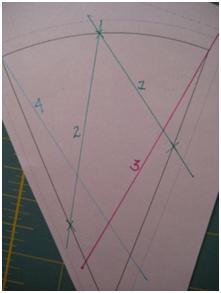
Mark and draw your stitching lines on your wedge as shown in the example below. Lines 1 and 2 must intersect somewhere along the top curve. Lines 3 must enter through the top right corner, cross line one, and end on the opposite side ( above or below line 2, whatever you want) Line 4 must enter through the top left corner and cross both Line 2 and Line 3. If you want, for blocks with a little more consistency and a more compass-like look, have lines 3 /4 meet the opposite sides below the marks for lines 1/2.


Place your first main fabric and background RST along the straightest edge. Hold it up to the light to align with Line 1 as shown below. Sew along your line, trim and press. Repeat for the remaining lines to get your wedge. The fabric placement is the same for this method as the one above. Lines 1/2 the background is sewn to the main fabric, line 3 is your 2nd color, line 4 is your 3rd color. Repeat for remaining 7 wedges. Do not remove paper.


FINISHING-BOTH METHODS

To finish your Wonky Compass block, trace the curved template onto your background fabric. Cut around the curve, on the line if using the above template, or making sure you have proper seam allowance if you aren’t. I like to leave the outer edges jagged, as shown below. This comes in handy for squaring up your finished block.


Fold your curve in half, find the center and pin. Set aside. Repeat for all curved templates.

Make 2 piles, 4 wedges in each pile. Pin one wedge from each pile RST at the top and bottom. Tear the paper from the pinned section that will be FACEDOWN on your machine. This lessens the bulk in your seam and you still have a stitching guide. Sew on the line. Tear paper from lines 3 and 4 on both wedges, leaving the paper on the center diamond shape and the background fabric. This makes 4 quarter wedges.


I use the three pin method as follows to sew my curved seams. You can use whatever method you are comfortable with.

Pin your curve template to your ¼ wedge at the sides and center. With the curve template facing you, sew your curved seam by easing the fabric into place with your finger or a tool. Press your seam away from the curve. Repeat for remaining ¼ wedges.


To trim, take your 6 ½” square ruler and line the 45 degree angle line with the center seam on your ¼ wedge. Trim the block as shown.


Pin 2 quarter compass blocks together, matching at the curved seam and the points. Sew a ¼” seam. Press open. It is critical that your press all your seams in the same direction in order for your block to lay flat! Repeat for remaining blocks. This makes two ½ blocks, which we sew together to make the compass block. Pin your ½ compass blocks together at the center and the curved seams. Sew your ¼” seam. Open the block and check that the seams all match in the center. Adjust if necessary, but do not press yet. A trick to get perfect seams the first time is to pin through the center of each block. With the pin in a vertical position holding your center point together, place 2 more pins, one to either side. Remove the vertical pin and sew. Voila! Practically Perfect Every Time!


We want our block to lay flat, so that means the seams need to all be pressed in the same direction.

In the picture below you can see that my seams rotate in a counter-clockwise direction. This is the direction I will press, but first I need to open the stitching in the center of my block.


Finger Press your seam open. Find the seams shown below by the pins. They are the seams that made your ¼ blocks into half blocks.


With your seam ripper, very carefully pull out a few stitches, making sure not to rip out the seam connecting your ½ compass blocks. It should look something like this.


Now you can finger press the seams so they lay in the same direction, in this case counter-clockwise. It should look like 4 tiny 1/2square blocks in the center of your seam, like shown. Press your seams flat. Turn you block right side up, and press, using steam to set your block.


Trim your block to 12 ½” square by aligning your ruler with the seams as shown. All that extra fabric you has around the outside is now trimmed away, and you have a perfectly square block!


I hope you enjoyed this tutorial! If anything seems unclear, or you need any help at all, please post below and I will help you as best as I can!

Happy Sewing!


The Threads that Weave

I have been sewing and crafting since I was 6 years old. All my life I have been surrounded by talented, creative women like my mother Sue, my Grandma Shirley, and my Auntie Pat. Every holiday, celebration or special occasion a quilt was gifted or created, and I always loved how the colors flowed, and how you could convey an emotion using nothing but little pieces of fabric.  Little did I know then, but I had been bitten by the quilt bug.

The first quilt I ever made on my own was one I had a dream about. My mom always tells the story best. “Why don’t you start with something small first, and see how it goes?” was her advice, but when it comes to quilting and art I have never really been one to test the waters before jumping right in. After a month of drawing up the design, picking the perfect colors, and some “Let’s see if this works…”, I showed my completed quilt to mom. After a minute of stunned silence, she gave me a hug and then introduced me to the website of Carol Bryer Fallert. I took one look at her quilt New Dawn and I was forever hooked.

To me, quilting is freedom. I have heard there are rules, but I would be hard pressed to tell you what they are. I love the smell of fabric, the feel and texture, and the stunning array of colors I can’t even put names to.  My favorite fabrics are batiks, and often I am inspired by a single piece of fabric that sings to me in a tune I can only answer with a needle and thread. I create my own patterns, drawn from the inspiration I find in countless books, magazines and other quilters. I am greatly influenced by the work of Sharon Schamber, Jacqueline De Jonge, Judy Niemeyer, Marilyn Badger and Claudia Clark Myers.  I have many of their patterns in my library, and look forward to someday completing them all at least once.

I wouldn’t be able to quilt the way I do without the love and support I find in my family. My wonderful husband has been known to make surprise stops at local quilt stores when we are on vacation, and doesn’t raise too much of a fuss when I spend a little bit more than I planned on a beautiful piece of fabric. He doesn’t like to admit it, but the man does have an eye for color!

The best part about quilting is the fellowship and commonality that quilters have. Quilting is a language all its own, and you can walk into any local quilt shop and find a friendly face and even friendlier advice.  I am honored to be able to share my quilt story with everyone, and I look forward to meeting many fellow quilters!

Circa 2003, one of my first quilts.

Welcome to my Quilty World!

Welcome to Stacey in Stitches!

I have finally started The Blog. Blogging is a new experience. I had never read a blog until a few months ago, even though my fellow guild members all talk about all the wonderful things they find and friendships they have made. I kept thinking that bloggers were mostly angst-ridden teenagers who never grew up and use blogging as a medium to vent. I am sure many still do, BUT, to my delight and surprise (and embarrassment that it took me FOREVER to actually discover this), it is a wonderful way to meet people with new and inspiring ideas, and to learn new things about the things you already love! Like QUILTING!

I love to quilt. I have been quilting for 10 years now, and there is no foreseeable point in the far future when I might ever stop. Maybe if I lose both hands, but as long as they have helper monkeys to run the fabric through for me I will be fine! I can’t even run out of room for my fabric stash, because let’s face it, that is what Rubbermaid containers and crawl spaces were made for! Thank goodness for understanding husbands and partners, though I think they all secretly think if they complain too loudly that we will hem all their pants 3 inches too short!
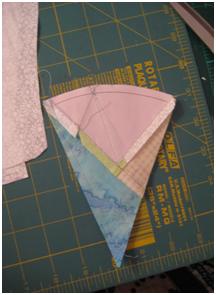
So about me…..I am a founding member of the Vancouver Modern Quilt Guild, an although my quilts are not what many would call modern, they certainly aren’t “traditional” either. I design and sell quilts and quilt patterns.  I am also a new Mom to my cute-as-a-button needs-more-quilts son who was born in March of this year, so if I devote a blog post or two please bear with me. He is my first after all.

As I get started into the world of Modern Quilting, blogging, and all that fun crafty stuff, I hope you enjoy the journey with me!